Diffraction


What is diffraction?
- It is the spreading of a wave when it encounters an obstacle or a slit.
- In this course, we primarily use the term to describe single-slit interference.
- There is no fundamental difference between diffraction and interference.
- Conventionally, the term diffration is used when the resulting wave arises from the interference of a large number or a continuium of sources.
- A single slit could be modeled as inifinitely many small slits lining up together.
For a single-slit of width $a$, destructive interference occurs at the angle give by:
Compare with the double-slit inteference side by side:
| Single-slit | Double-slit |
|---|---|
| $a \sin\theta_m = m \lambda$ | $d \sin\theta_m = m \lambda$ |
| $a$: width of the slit | $d$: separation between two slits |
| minima for integer $m\neq 0$ | maxima for integer $m$ |
| $m=0$ gives the central maximum. | $m=0$ gives the central maximum. |
| central maximum twice as wide as other maxima | central maximum is approximately the same width as other maxima |
| central maximum much brighter than other maxima | central maximum is roughly the same brightness as other maxima (for very narrow slits) |
Simulation - Single Slit Diffraction
Single-Slit Diffraction
A lab manual based on this simulation is available here.
Drag on the barriers to change slit width. Drag the screen and the circle to change their positions.
The phasor diagram can also be moved by dragging on the lime-colored dot.
Red/blue are used to represent long/short wavelength for illustrative purpose only. The numerical
values of the wavelength in this simulation do not in fact match with the actual wavelength of
visible light.
Location of the dark fringes
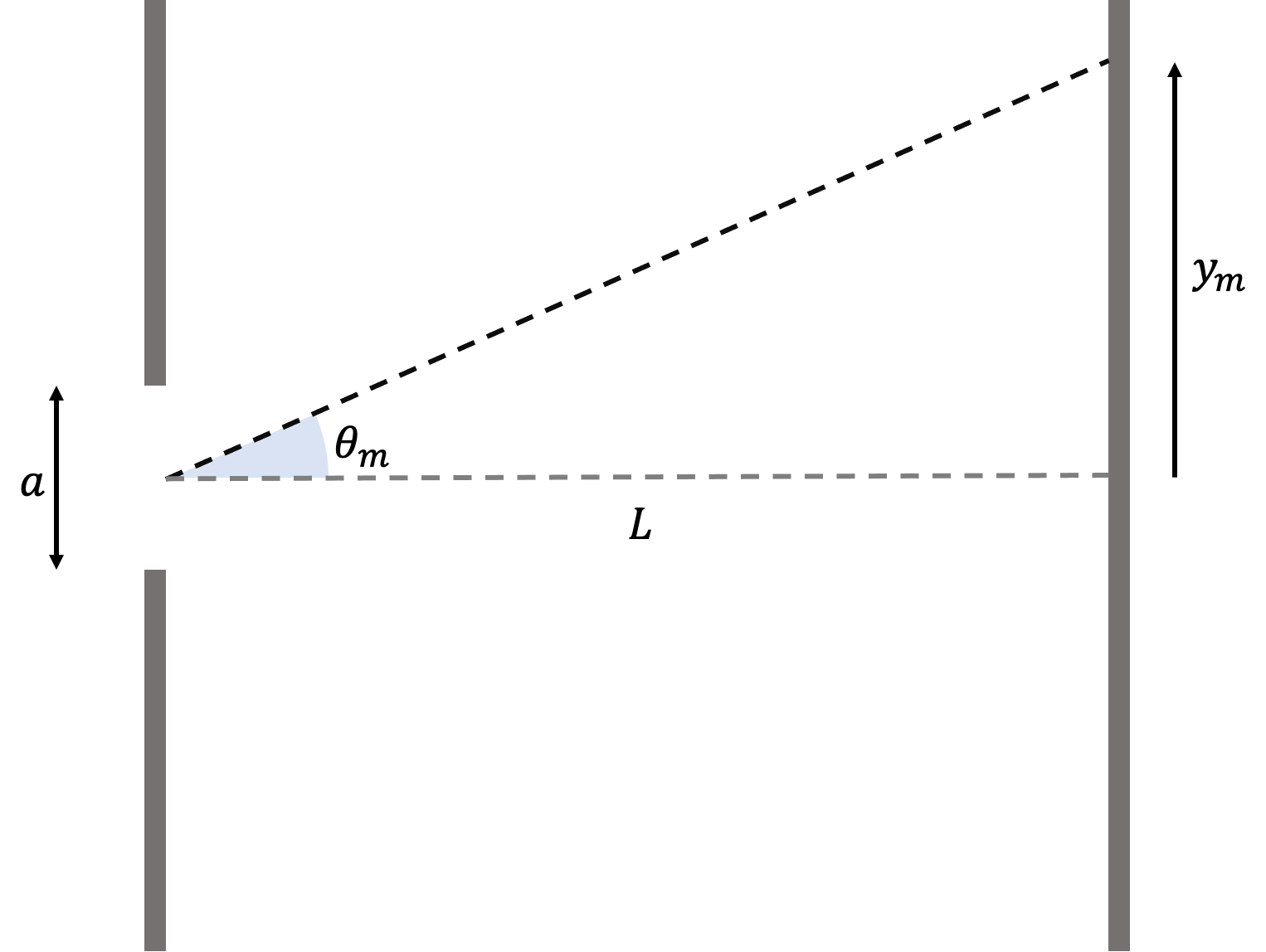
Simple trigonometry tells us the vertical position of the $m$-th order dark fringe is: $$ \begin{eqnarray} \tan \theta_m &=& \frac{y_m}{L} \\ \Rightarrow y_m &=& L \tan \theta_m \end{eqnarray} $$ where $L$ is the separation between the viewing screen and the slit.Applying the small angle approximation, we have: $$ \begin{eqnarray} y_m &=& L \tan \theta_m \approx L \sin \theta_m \tag{*} \end{eqnarray} $$
But we know the $m$-order minimum obeys: $$ \begin{eqnarray} a\sin\theta_m &=& m\lambda \\ \Rightarrow \sin \theta_m &=& m \frac{\lambda}{a} \end{eqnarray} $$ Put this into (*) gives: $$ \begin{eqnarray} y_m &\approx& L \sin \theta_m \\ &=& L (m \frac{\lambda}{a}) \\ \Rightarrow y_m &\approx& m \frac{\lambda}{a} L \end{eqnarray} $$ Remember $m\neq 0$ for the minima.
For single-slit, because the central maximum is so much brighter than all other maxima, we usually only care about the central maximum. The dark fringes on both sides of the central maximum is $m=\pm 1$: $$ \begin{eqnarray} \theta_1 &\approx& \sin \theta_1 = \frac{\lambda}{a} \\ y_1 &\approx& \frac{\lambda}{a} L \end{eqnarray} $$
The width $w$ of the central maximum is twice that of $y_1$: $$ w = 2 y_1 = 2\frac{\lambda}{a} L $$
$y_m$ without small angle approximationFor waves of long wavelengths, such as sound, radio waves, microwaves, one should not use the small angle approximation (because of large angle $\theta$). In this case, the minima are at ($m\neq 0$): $$ \begin{eqnarray} a\sin\theta_m &=& m\lambda \\ \Rightarrow \theta_m &=& \sin^{-1} (m \frac{\lambda}{a}) \end{eqnarray} $$ Putting into $y_m = L \tan \theta_m$ gives: $$ y_m = L \tan (\sin^{-1} (m \frac{\lambda}{a})) $$ Most of the problems in this course are for visible light, so it is usually safe to make the small angle approximation.

